Friday, November 16, 2012

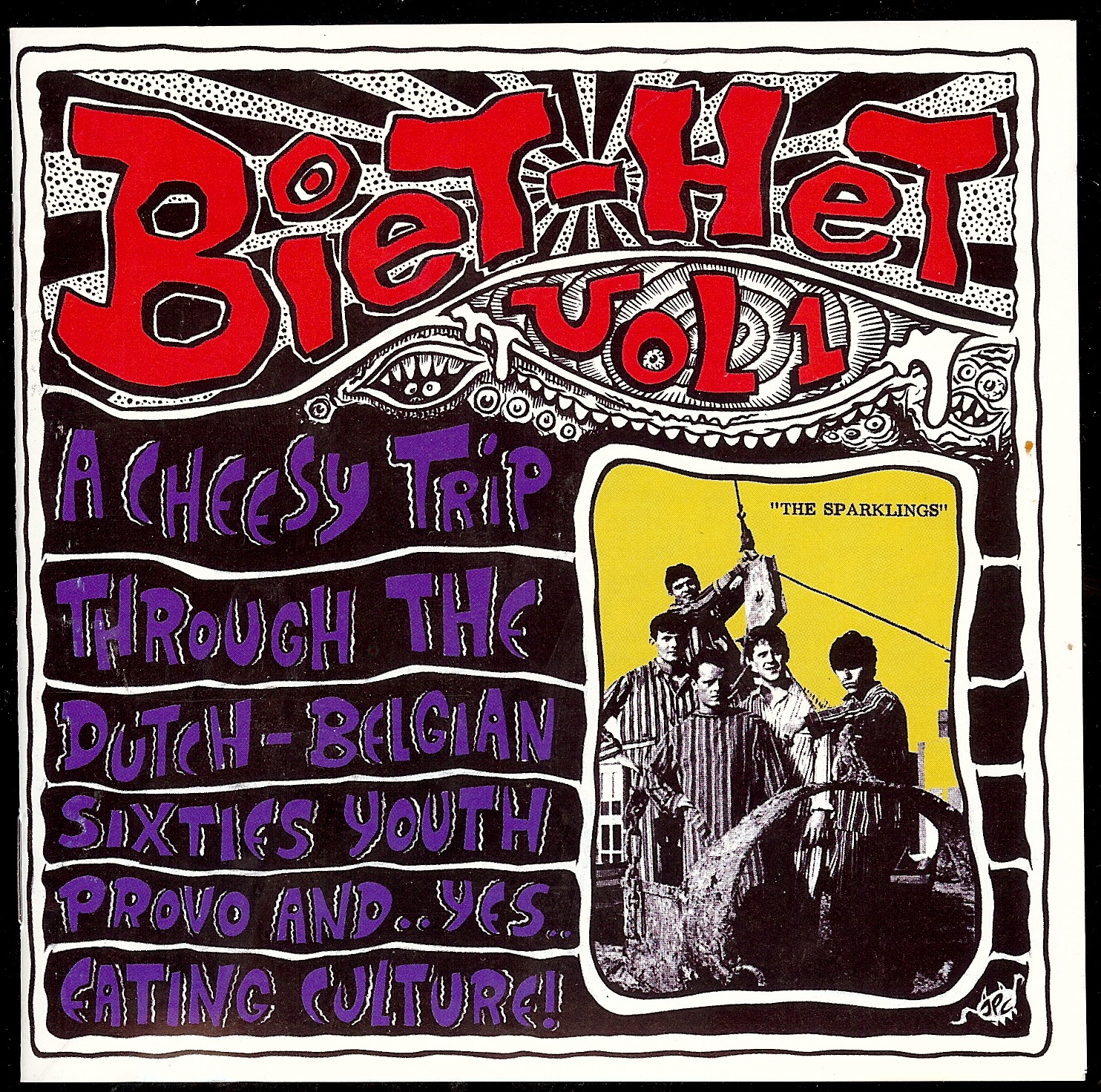
Biet-Het Vol 1 : A Cheesy Trip Through the Dutch-Belgian Sixties Youth Provo and...Yes..Eating Culture! (Distortions, 1998)


"Who ever listens through these thirty songs objectively will despair and ask: "What on earth went wrong with Dutch popular music after these unprecedented peak years?" (And let's not forget the Belgian contributions to this compilation!) The pure, raw productions, the textual and musical originality and the amazing emotional charge of these records create a gap with contemporary Dutch music which, in meters, surpasses the boundaries of the universe easily. these are the young and passionate singing their hearts out! This CD contains the essence of all of Dutch society of the sixties. Who ever listens...will personally experience the sixties retroactively." (Drs J. Pate, from the liner notes)

Hyperbole aside, this out of print CD comp of rocking Dutch-Belgian garage psych rave-ups is chock full of fuzzy freakbeat, goofy one-offs, a few sweet vegetables, and one righteous cover of the Kinks' Don't You Fret. It rules. Let's just say its "Solid as a Rock!" Enjoy...


1. The Mokum Beat Five - Trouw Nooit (Never Marry) (Delta '66
2. The Eurfians - Waaro (Imperial '66)
3. The Jokers - Zet Die TV Af! (That TV Sale!)
4. The Fallouts - De Vlieg (The Fly) (Funckler '66)
5. Peter J. Muller - Links De Kinks (Delta '66)
6. Bob Bouber - Ik Wil Me Donalduckie (I want me Donalduckie) (Phillips '68)
7. Eddy Dyan & The Saints - Lady Sex
8. Ronnie & The Ronnies - Daar In De Wildernis (There in the bush) (Delta '66)
9. NV Groep 65 - Tanger (Delta '66)
10. Ruud Knolraap & The Sweet Vegetable - Sperciebonen
11. Ernie Bender & The Robbins - Cleopatra (Phillips '66)
12. The Clungels - Dat Had Ik Nog Nooit Gedaan (That I had never done) (Artone '66)
13. Aart Brouwer - Hé Pssst (Phillips '63)
14. In Istanboel
15. Hardstikke Dood
16. Hugo De Groot - Ze Nemen Me Eindelijk Mee (the Dutch version of They're coming to take me away haha) (Havoc '66)
17. De Fouryo's - Surf-City (Decca '63)
18. Tony Light - Laat Me Gaan (Me lets go) (Atrone '68)
19. De Clichee-Mannetjes - Lekker Legbad (Nice Legbad) (Omega '66)
20. The Mokum Beat Five - Wat Scheel Je Nou (What squint-eyed you nou?) (Delta '66)
21. Het Pocomania - Peterselie (Parsley) (Fontanna '68)
22. The Eurfians - Opa's Beat (Imperial '66)
23. Ruud Knolraap & The Sweet Vegetable - Geurige Gouden Tinten (Fragrant gouden at)
24. The Sparklings - Ach Barst! (Ah go to hell) (CNR '66)
25. Het - Spat Niet Met Pap (Do not splash with porridge) (Fontana '66)
26. Freddy Scot & The Condors - Kom Maar Hier (RCA '64)
27. Peter J. Muller - Beter Langharig Dan Kortzichtig (Better long-haired than short-sighted) (Delta '66)
28. Johnny Lion - Wees Niet Bang (Phillips '66)
29. Ronnie Schutte - Ze Zegge (Them say) (Delta '66)

Thursday, November 1, 2012

The Neon Vernacular - Halloween Show


The Neon Vernacular's Halloween radio broadcast. Our show, hosted by Ladybug and me, streams live on http://praradio.org, every Sunday 6-8pm Pacific Time. Occassionally, we'll post episodes to our MixCloud account. 

Tuesday, October 30, 2012

Friday, October 26, 2012

Re-Ups 4: All Hallows Edition


Can't Stop, Won't Stop, with these endless ADrive re-ups. On the other hand, full of rigor mortis just like a tortoise, might be the better reference in terms of recent pacing around here, but I digress. The All Hallows season is upon us, and nows the perfect time for Nate Ashley's incredible Written in Blood horror music series, so I'd be doing us all a disservice not to mention that Nate's uploading newly upgraded 320 versions of his monstrous collection over at his brand new blogHold it now, hit it! 


V/A- Written in Blood *320 upgrades added all week @ Nate Ashley’s new blog


The Orlons- Not Me (1963)


THE PEACE!!- Black Power


David Welsh- Blue Lightning Accent (1980)

Jimi Paulix (David Welsh)-Live at the House Compound (2010)

 The Residents- Diskomo / Goosebump [with Snakefinger] (1979)


Warda- Esmaouni (1974)


V/A- Yellow Pills: Prefill (Numero 004)


David Hykes - The Harmonic Choir : Hearing Solar Winds (1983 - Ocora 558 607)


'The Harmonic Choir was formed by David Hykes in 1975. An accomplished experimental filmmaker witha deep interest in traditional and sacred music, Hykes had already acquired broad familiarity with the music of West and Central Asia when he first heard the Hoomi singing (literally "throat singing") indigenous to western Mongolia, and the overtone chanting of Tantric Tibetan Buddhism. 

In the Hoomi tradition, singers produce fundamental tone in the bass or baritone range, and then by extremely precise modulation of the of the abdominal muscles, chest, and vocal apparatus - larynx, tongue, jaws, cheeks, and lips - project simultaneously a higher tone or tones, related in frequency to the fundamental tone by whole number ratios. These higher frequencies are called "overtones" or "harmonics". In producing harmonics, the voice acts like a kind of sonic prism, "refracting" sound along a frequency spectrum which extends upward from the fundamental tone.

...For David Hykes, the significance of the harmonic series as both a source and an aesthetic standard for musical composition lies in its organic lawfulness and proportion. His work begins at the point where a singer can articulate at will various harmonics in the series. From there, it moves towards a living research into the unexplored realms of sound made accessible by harmonic singing, where acoustical order can become truly iconic to what is at once a more universal world of number.

In many cultures, it has traditionally been the role of music to express a sense of the order of the universe - an order which man can aspire to understand and to look for in himself. As a "traditional" music of present-day culture, perhaps the singing of the Harmonic Choir can fulfill the same pupose.' (Theodore Levin, album notes)

'This recording was made in l'Abbaye du thoronet, a 12th-century Cistercian monastary in Provence, where I had previously brought the Choir in 1978. The simple harmonic geometry of the Abbey seemed perfectly proportioned to magnify the Choir's music and let it resonate within its sacred space. Working there was an incredible challenge: our sensations, our breathing, and even our thoughts and emotions became intensely amplified. We recorded most of the nights of August 6 and 7, and i wish to express my deepest thanks to Pierre Toureille and Michel Lepage and his crew for their sensitivity and earnestness in seeking with us the ideal results.' (David Hykes, album notes)


 Hermetic harmonics in choral a cappella. Recommended material for an hypnotic late night zone-out, drone-out. The new age is upon us. 2012, Quetzalcoatl, Oneohtrix Point Never, and so on. 

The Harmonic Choir have been a recent discovery for me. Turns out Hykes had scored Baraka and Meetings With Remarkable Men, both of which I'd enjoyed years ago, but had never looked too deeply into their soundtracks. It looks like Rootblog, among others, have upped some other prime offerings from Hykes & The Harmonic Choir. Now here I am, casting a fresh rip of this LP out into these interweb's Solar Winds. And while it had long been out of print, it has since come to my attention that a remastered version of Solar Winds is now available for purchase from the likes of CDBaby. And so, in the interest of promotion & courtesy (and of keeping this blog), the links below will be available here at GC for only the next two weeks. Enjoy.


David Hykes - The Harmonic Choir : Hearing Solar Winds (1983 - Ocora 558 607) 

*Links removed (see write-up, above)

Side 1
Part I : Rainbow Voice
Part II : Multiplying Voices at the Heart of the Body of Sound
Part III : Arc Descents - The Fall
Part IV : Gravity Waves

Side 2
Part IV : Gravity Waves (continued)
Part V : Lens by Lens
Part VI : Telescoping & The Flight of The Sun
Part VII : Two Poles; Ascent
Part VIII : Ascending and Descending


Friday, October 19, 2012

Super Djata de Bamako -- Vol. 2 (1983 -- Musique Mondial, MAD 004) *Flac


"Zani Diabaté, prominent guitar player in the Super Djata Band, one of the most popular bands from Bamako during the 1980s, joined the Ballet National in 1963, where he sang, danced and played guitar, kora, balafon and percussion. In his spare time, he would play in Harmonica Jazz, where he played harmonica, and later he formed the Ganoua Band with Daouda Sangaré on kamalen n'goni and on vocals, and with Maré Sanogo on djembé. In the early 1970s, the Ganoua Band was appointed the third National Orchestra of Mali (Formation C). When they were left without work, Zani and his fellow band members decided to switch to a private band which they named (Super) Djata Band. It was in 1974 that they started recording for Radio Mali.

The sound of Super Djata, based on the, compared to the mellow malinke sound of for instance the Rail Band, hard hitting Bambara rhythms and melodies, is highly coloured by the outstanding guitar playing by Zani Diabaté." (Musiques-Afrique)


Friends, you can still grab the (better sounding?) mp3 version of Super Djata's Vol. 2 at the invaluable World Service music blog. And, be sure to show some love over at WS, too...Not only for showing extraordinary taste and generosity in having shared our interweb's first best rip of Vol. 2 (and more!), but also for WRLDSERV's  own heartfelt personal insights and recollections about the life & career of Zani Diabaté & co.

Huge thanks to  DJ Cuica for lending out this platter that matters.  Djata truly brought this afternoon to life back here at the homestead. Heavenly sounds. 


Monday, October 15, 2012

Baden Powell- Baden : O Som de Baden Powell *1968 (Elenco, ME-48)


Baden. This handsomely designed Brazilian pressing, originally released by Elenco in 1968, serves up a distinctive handful of subtly produced bossa and samba outtakes that were recorded at Powell’s 1966 Tristeza on Guitar sessions. Lovely stuff. When compared, the overall vibe on Baden is clearly the more reflective of the two.


Baden Powell- Baden : O Som de Baden Powell(Elenco, ME-48)
Recorded 1966, released 1968


1 Canto de Ossanha * (Baden Powell - Vinicius de Moraes) 6´53
2 Tristeza (Haroldo Lobo - Niltinho) 3´10
3 Manhã de carnaval (Antônio Maria - Luiz Bonfá) 3´00
4 Round about midnight * (Hanighen - T.Monk - C.Williams) 5´18
5 Invenção em 7 ½ * (Baden Powell) 5´00
6 Canto de Xangô (Baden Powell - Vinicius de Moraes) 4´32
7 Percussão e batuque ** (Baden Powell) 3´07
8 Lamento ** (Vinicius de Moraes - Pixinguinha) 3´27
9 Saravá (Baden Powell - Vinicius de Moraes) 3´25
10 Das rosas* (Dorival Caymmi) 5´26


Thursday, October 4, 2012

(V/A) Let's Get Loose : Folk And Popular Blues Styles From The Beginnings To The Early 1940s (New World, 1978)


"[In the early 20th] century, professional traveling entertainers in the South, many of them women, began to incorporate blues into their stage acts. In 1912 the first blues sheet music appeared, and very shortly the blues moved into the mainstream of white popular music as well as southern white folk music. In 1920 the first blues record by a black vocalist appeared, initiating a flood of thousands of commercial recordings that continues today. These popularizing trends took place in a historical context of increasing migration of rural southern blacks to the northern urban centers. Blues have continued to flourish in the ghettos, mainly among people with strong and recent ties to the South. Hastened by the hit and star system of the record industry, a series of new performance styles grew up, containing elements that reminded the listener of the South but also reflecting the increasing sophistication and complexity of city life. Styles emanating from the cities had an influence on southern rural blues singers through records and through the recording artists' personal appearances, while at the same time the urban blues scene was nourished by a steady stream of new performers arriving from "down home." The blues on this album, all from commercial recordings, illustrate the major styles in which blues were performed from the turn of the century to the outbreak of World War Il. Side One contains styles already in existence at the advent of recording, including examples of early white folkand popular-blues styles. Side Two presents styles that developed or came into prominence largely after or as a result of commercial recording." (album notes excerpt)


Just scored a heap of these 70's New World Records LP comps from Mississippi Records, on the cheap. This one's sporting some prime cuts, and there's plenty more like this that are on the way. 


A1      Yank Rachell, Sonny Boy Williamson, Washboard Sam & Alfred Elkins - PeacH Tree Blues
A2 Pillie Bolling – Brownskin Woman
A3 The Johnson Boys – Violin Blues
A4 Monarch Jazz Quartet Of Norfolk – What's The Matter Now
A5 Buck Mountain Band – Yodeling Blues
A6 Hattie Hudson – Doggone My Good Luck Soul
A7 Clara Smith – Let's Get Loose
A8 George O'Connor – Nigger Blues
B1 Tyus And Tyus – Dad's Ole Mule
B2 Rufus & Ben Quillian – Keep It Clean
B3 Scrapper Blackwell - & Leroy Carr  Blue Night Blues
B4 Walter Roland – House Lady Blues
B5 Harlem Hamfats – I'm Cuttin' Out
B6 Tommy McClennan – Deep Blue Sea Blues
B7       Big Bill Broonzy, Sonny Boy Williamson, Alfred Elkins & Blind John Davis - Love Me, Baby
B8 The Five Breezes  – My Buddy Blues


Sunday, September 16, 2012

Escola De Samba Da Cidade ‎– Batucada Nº 3 : The Exciting Rhythm Of The Wild Brazilian Carnival (Philips, 1971)


"This album was conceived and produced by Armando Pittigliani, one of the biggest music producers in Brazil. He produced the first albums of bossa nova by [artists like] Carlos Lyra, Nara Leão, Os Cariocas and Tamba Trio, was also producer of Baden Powell, Jair Rodrigues, CY Quartet, Jackson do Pandeiro, Agnaldo Timothy, Elis Regina, among many others. [He] played an important role in song festivals, as a juror, collaborator and producer. It was he who had the bright idea to record the likely winning songs before the end of the festival. So, when the winner was announced, the recording was ready. The next day, stores had the disc with the winning songs on the shelves....

This album, recorded in 1971, aims to present some typical Brazilian rhythms, especially those related to samba. The album is entirely instrumental, and the rhythms are shown in a very didactic [way]" (Acervo Origens)


A boss 70s brazilian LP of crisply recorded (studio) batucada. Breaks all day for you beat-diggers out there. Many thanks to my compadre, Bill, who was kind enough to rip this outstanding record for GC. Enjoy!

Escola De Samba Da Cidade ‎– Batucada Nº 3 : The Exciting Rhythm Of The Wild Brazilian Carnival (Philips, 1971)***320kbps mp3

1.   Batucada De Apresentação 5:07
2.   Partido Alto 4:15
3.   Samba Em Vários Andamentos 6:53

1.   Apito Na Batucada 3:12
2.   Samba De Roda 5:03
3.   Improvisos Na Batucada 5:05
4.   Ritmo De Macumba 3:55

Saturday, September 15, 2012

Massive Re-Ups #3 (Lots of requests)


Spent most of today getting busy with this massive batch of re-ups. Lots of requests honored down below. Some of these date way, way back to the very first months of GC -- Well before I had a scanner, or was even ripping things in 320, much less lossless. Old-School jams and whatnot.

Paz!


Wendell Stuart & The Downbeaters (197x, Elite ER-1006)