Saturday, September 15, 2012

Massive Re-Ups #3 (Lots of requests)


Spent most of today getting busy with this massive batch of re-ups. Lots of requests honored down below. Some of these date way, way back to the very first months of GC -- Well before I had a scanner, or was even ripping things in 320, much less lossless. Old-School jams and whatnot.

Paz!


Wendell Stuart & The Downbeaters (197x, Elite ER-1006)


Wednesday, August 29, 2012

V/A : The Heart of Mexico -- Exciting Musica Tipica, Recorded in Mexico (Gene Norman Presents, 1961)


"The Music in this album represents The Heart of Mexico in all its facets...With all its color and sensitivity! The Bright Mariachi, with its highly emotional and fun-loving sound...The romantic and sentimental music of the Trio, whose soft strumming guitars speak of love and serenades in the night: as well as the gaiety and spontaneity of the piquant rhythm of the Jarocho groups...All this music, in its most sincere form, unadulterated, honest and clear as the azure skies under which it was born, gives us the most accurate insight into...The Heart of Mexico." (Back cover)

This 1961 Gene Norman comp offers up a fine selection of live-recorded performances from a healthy handful of excellent Mexican combos. Vinyl rip by yours truly. Enjoy! 


V/A : The Heart of Mexico -- Exciting Musica Tipica, Recorded in Mexico (Gene Norman Presents, 1961) 320 mp3 + Flac

Side A

1. La Rondalla de Tijuana - Guadalajara
2. San Martin Trio - Las Alteñitas
3. La Gloria Quintet - La Malagueña
4. Maricela y Mariachi Corral - Ay! Jalisco, No Te Rajes
5. Ensueño Trio - Cuando Vuelva a Tu Lado
6. Mariachi Corral - La Cecilia

Side B

1. Quarteto Boca del Rio - El Cascabel
2. La Rondalla de Tijuana - Rayando el Sol
3. Maricela y Mariachi Corral- Me He de Comer Esa Tuna
4. Los Pajaritos Trio - La Adelita
5. Mariachi Corral - Cocula
6. La Rondalla de Tijuana - Cancion Mixteca


Tuesday, August 14, 2012

Ustad Vilayat Khan -- The Supreme Genius of Ustad Vilayat Khan (1968 - HMV/EMI India, EASD-1332)


"Born at Gouripur (now in East Pakistan [Bangladesh] )in 1924 in a family with a great musical tradition, Vilayat Khan is sixth in an unbroken line of maestros going back to the Mughal period. His father, the late Ustad Inayat Khan, still remembered as one of the greatest sitarists of all time, initiated young Vilayat in the art of Sitar playting, though this guidance was lost to Vilayat at the early age of thirteen due to the death of his father. Dedication and discipline, however, carried him through and to such heights that at a relatively young age his virtuosity was recognized not only in India but abroad also. He has played to appreciative audiences in UK, Europe, USSR, East Africa and Afghanistan. Just as Sartre's rejection of the Nobel Prize created a storm in European intellectual circles, Vilayat Khan's polite but firm refusal of a Sangeet Natak Akademi award created a sensation among musical circles in India three years ago."
(From the cover notes)


"A creative genius like Vilayat was not content with mere presentation of his parent baaz. He remodelled the Sitar in many ways like removing the second gourd, changing the strings and tuning system. His technical contribution, exquisitely attuned to the various gradations of Raga delineation, elucidative in practical exposition, has become a reference point for the art of perfect Sitar playing...

For his magnificent solos, his immemorial duets, Ustad Vilayat Khan will live on in the hearts of millions for time immemorial, as the Shahenshah of Sitar. "   (Obituary, ITC Sangeet Resarch Academy)


"Fans and media alike liked to play up Vilayat Khan's rivalry with and animosity towards Ravi Shankar. However, in calmer moments Vilayat would admit there was not much to it. His animosity for the politics and institutions of India's cultural life was another matter. In 1964 and 1968, respectively, he was awarded the Padma Shri andPadma Bhushan awards – India's fourth and third highest civilian honours for service to the nation – but refused to accept them, declaring the committee musically incompetent to judge him." (Wikipedia, Controversy)


Ustad Vilayat Khan -- The Supreme Genius of Ustad Vilayat Khan (1968 - HMV/EMI India, EASD-1332)


Sitar-Raga : Darbari Kanada

Side A: Alap & Jhala
Side B: Gat In Teentaal

Tabla: Shankar Ghosh


Sunday, August 12, 2012

Animal Collective : Centipede Radio Transmission 3


Ghost Capital is stoked to go on-air as one of today's guests on Animal Collective's Centipede Radio Transmission 3, hosted by Avey Tare. Atlas Sound and The Blackouts are this week's other guests. The show starts in about 30 minutes. Listen Up!

Via FACT: The third episode of Animal Collective’s Centipede Radio will be broadcast live via radio.myanimalhome.net this Sunday night / Today at 9pm EST (6pm Pacific).
This week’s show is hosted by the band’s Avey Tare, following episodes helmed by Panda Bear and Deakin (both archived and available to stream on the site). It will feature guest DJ mixes from Atlas Sound, The Blackouts and Ghost Capital.
Animal Collective Radio is a collaboration between the band, their label Domino and The Creators Project, designed to promote their new album, Centipede Hz, which us due out on September 3. You can stream the last show, which featured Haunted Graffiti and more, here. 

Saturday, August 11, 2012

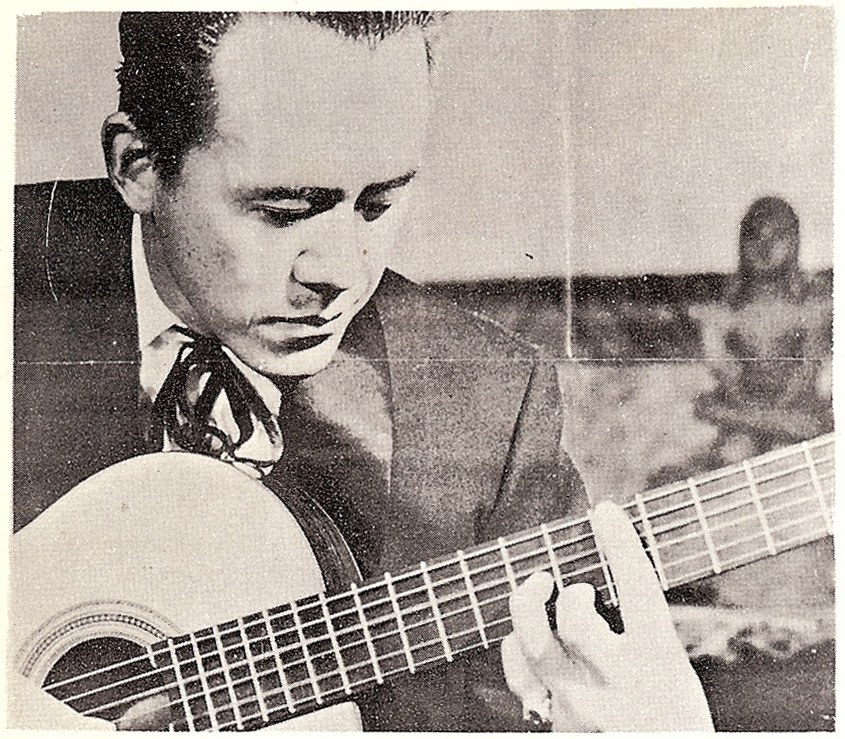
Atsumasa Nakabayashi Trio - Melody of Japan (Denon, ALS-4049) 中林淳真ギター三重奏団 - 日本のメロディ


"Atsumasa Nakabayashi was born in Tokyo in 1927. He began his musical studies in Japan, with the teacher Yasumasa Obara, and perfected the technique and interpretation of the guitar in Spain under the leadership of Narciso Yepes and Jose Luis Gonzalez. In 1958 he won the 1st. Prize of the International Guitar Competition in Tokyo, and was awarded by the Ambassador of Spain. In 1964 he appeared at Carnegie Hall in New York, as the first Japanese guitarist to hold this site. Invited by the Department of Cultural Affairs of Cuba, gave recitals in Havana and Santiago de Cuba. In 1984 he won the 1st. Composition Competition Prize Morishige Takei held annually in Tokyo for his suite "Dance No. 1". (Source)


A lovely survey of classic Japanese melodies arranged & performed by Nakabayashi's excellent guitar trio. Release date currently unknown. I was also unable to find the tracklist (in Japanese or English) transcribed anywhere, online. Japanese speakers, your assistance with this would be greatly appreciated. Is my observation correct that a Nakabayashi CD of the same name; 日本のメロディ, seems to have an entirely different tracklist? Enjoy!


Atsumasa Nakabayashi Trio - Melody of Japan (Denon, ALS-4049)


"Nippon No Merodei"


Sunday, July 29, 2012

Dowland : "Lachrimae or Seaven Teares" and Fourteen Other Dances -- Eugene Müller-Dombois (lute), Viola da Gamba Quintet of Schola Cantorum Basiliensis (1968 -- RCA Victrola, VICS-1338)


This set of Dowland pavanes and other dances has steady calmed my worn-out nerves throughout the course of this entire month. To be true, it's been nearly the only newly-acquired LP that I've had on deck until late last week. I reckon I've found Lachrimae, in particular, uplifting in that reflective, somber, minor key kind of way. I recognize that Renaissance chamber sounds are something a change of pace for GC, but really...Isn't that why we're all here in the first place -- Looking for new sounds and revelatory surprises? Besides, if I've played it that much, seems like the proof is in the pudding...


"Very little is known of John "the Bard" Dowland's early life, but it is generally thought he was born in London. Irish historian W. H. Grattan Flood claimed that he was born in Dalkey, near Dublin, but no corroborating evidence has ever been found either for that statement or for Thomas Fuller's claim that he was born in Westminster.[2] In 1580 Dowland went to Paris, where he was in service to Sir Henry Cobham, the ambassador to the French court, and his successor, Sir Edward Stafford.[3] He became a Roman Catholic at this time.[4] In 1584, Dowland moved back to England where he was married. In 1588 he was admitted Mus. Bac. from Christ Church, Oxford.[5] In 1594 a vacancy for a lutenist came up at the English court, but Dowland's application was unsuccessful - he claimed his religion led to his not being offered a post at Elizabeth I's Protestant court. However, his conversion was not publicized, and being Catholic did not prevent some other important musicians (such as William Byrd) from having a court career in England.[3]
From 1598 Dowland worked at the court of Christian IV of Denmark,[6] though he continued to publish in London.[7]King Christian was very interested in music[8] and paid Dowland astronomical sums; his salary was 500 daler a year, making him one of the highest-paid servants of the Danish court.[9] Though Dowland was highly regarded by King Christian, he was not the ideal servant, often overstaying his leave when he went to England on publishing business or for other reasons.[8] Dowland was dismissed in 1606[8] and returned to England;[9] in early 1612 he secured a post as one of James I's lutenists.[10] There are few compositions dating from the moment of his royal appointment until his death in London in 1626.[11] While the date of his death is not known, "Dowland's last payment from the court was on 20 January 1626, and he was buried at St Ann's, Blackfriars, London, on 20 February 1626."[12]
Two major influences on Dowland's music were the popular consort songs, and the dance music of the day.[13] Most of Dowland's music is for his own instrument, the lute.[14] It includes several books of solo lute works, lute songs (for one voice and lute), part-songs with lute accompaniment, and several pieces for viol consort with lute.[15] The poetRichard Barnfield wrote that Dowland's "heavenly touch upon the lute doth ravish human sense."
One of his better known works is the lute song "Flow my tears", the first verse of which runs:
Flow my tears, fall from your springs,
Exil'd for ever let me mourn;
Where night's black bird her sad infamy sings,
There let me live forlorn.
—John Dowland, [16]
He later wrote what is probably his best known instrumental work, Lachrimae, or Seaven Teares, Figured in Seaven Passionate Pavans, a set of seven pavanesfor five viols and lute, each based on the theme derived from the lute song "Flow my tears".[17] It became one of the best known collections of consort music in his time. His pavane, "Lachrymae antiquae", was also popular in the seventeenth century, and was arranged and used as a theme for variations by many composers.
Dowland's music often displays the melancholia that was so fashionable in music at that time.[18] He wrote a consort piece with the punning title "Semper Dowland, semper dolens" (always Dowland, always doleful), which may be said to sum up much of his work.[19]" (Wikipedia)

Eugen Dombois (or Mueller-Dombois) is best known as an instructor at the Schola Cantorum in Basel, where he has trained a whole generation of major lute players. (Source: *roughly translated)


John Dowland : "Lachrimae or Seaven Teares" and Fourteen Other Dances -- Eugene Müller-Dombois (lute), Viola da Gamba Quintet of Schola Cantorum Basiliensis (1968 -- RCA Victrola, VICS-1338)


320 mp3 + Flac


1. Lachrimae or Seaven Teares
2. Lachrimae Antiquae
3. Lachrimae Antiquae Novae
4. Lachrimae Gementes
5. Lachrimae Tristes
6. Lachrimae Coactae
7. Lachrimae Verae


1. M. John Langton's Pavan - Sir John Souch His Galliard - M. Nicholas Gryffith His Galliard - M. Giles Hoby's Galliard - M. George Whitehead His Allemande
2. Sir Henry Umpton's Funeral - M. Henry Noel His Galliard - Captaine Digorie Piper His Galliard - M. Buctons' Galliard
3. "Semper Dowland semper dolens" - The King of Denmark's Galliard - The Earl of Essex Galliard - M. Thomas Collier His Galliard - Mrs. Nichols' Allemande


FYI, Many more re-ups are on the way. Tonight or tomorrow. Peace.

Friday, July 20, 2012

Fresh Links : A Mountain of Re-Ups


Fresh ADrive links for a huge pile of vinyl rips taken down with my recent suspension from Mediafire. More in the works for Monday. Dig it, friends.


Aquarium Drunkard Presents :: Ghost Capital Mixtapes I + II + III